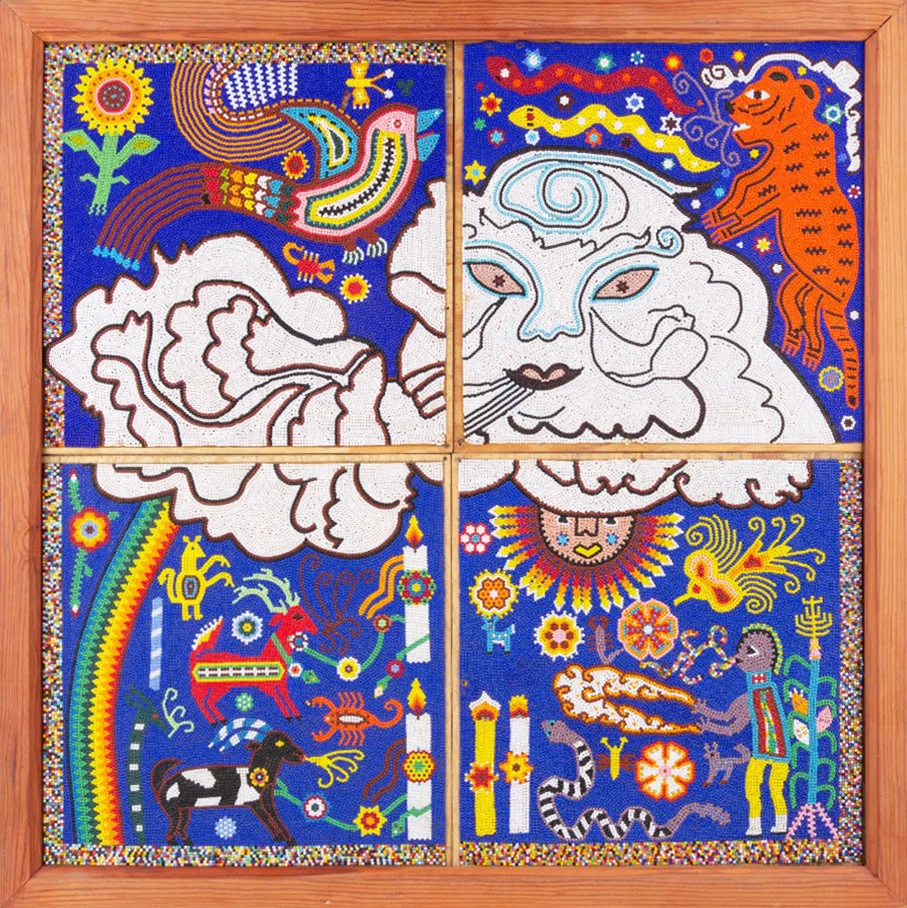
Eka Teiwari
Santos Motoapohua de la Torre (1942–)
2020
Beads, beeswax and plywood · 60 × 60 cm
The title names Eka Teiwari, the god of the wind, whom Stacy B. Schaefer, in People of the Peyote (1996), spells Eka Tewari, “the wind god.” She records a woman who, “deep within the peyote,” was visited by him: “It was the god of the wind Eka Tewari (Wind Person). He spoke to her and told her she had to remember his song.”
A great cloud with a face spreads across the top of the four panels, its lips pursed and blowing, with serpents in the sky beside it and a sun with a face beneath it. In a 1980 yarn painting by José Benítez Sánchez, explained by Juan Negrín, founding director of the Wixárika Research Center, the hair of Tatéi Nɨ'ariwame, “Our Mother Messenger of Rains,” turns into serpents, and “the serpents turn into rain and mists rising into the heavens, as well as serpents turning into rivers on earth”; the rain clouds themselves are embodied by ancestors, Squash Boy and Our Mother South Waters.
A big cat marked with short black stripes leaps beside the cloud, among stars. In the account of Johannes Neurath of Mexico's Museo Nacional de Antropología, five Wixárika peyote pilgrims stand for the five mythical hunters, the awatamete, each in charge of a direction and its animal: the south has tuwe, the jaguar (tigre), and the north maye, the puma (león). Carl Lumholtz, in Symbolism of the Huichol Indians (1900), wrote that “The tiger is the jaguar” and that “The tiger belongs to the fire.” In de la Torre's earlier mural Misterio y viaje de los tres espíritus sagrados, Juan Manuel López Rodríguez of the Universidad Autónoma Metropolitana reads one figure as “el jaguar, deidad de la cacería” (the jaguar, deity of the hunt).
In another 1980 yarn painting, by Yauxali and also explained by Negrín, the sun is Tayau, Our Father Sun. Candles are beaded in the lower panels; Mexico's Instituto Nacional de Antropología e Historia (INAH) writes that Wixárika candles “representan la luz del Sol y la conexión con las deidades” (represent the light of the Sun and the connection with the deities).
Untitled is the same composition, with changes in color and detail.