Untitled
Santos Motoapohua de la Torre (1942–)
2019
Beads, beeswax and plywood · 60 × 60 cm
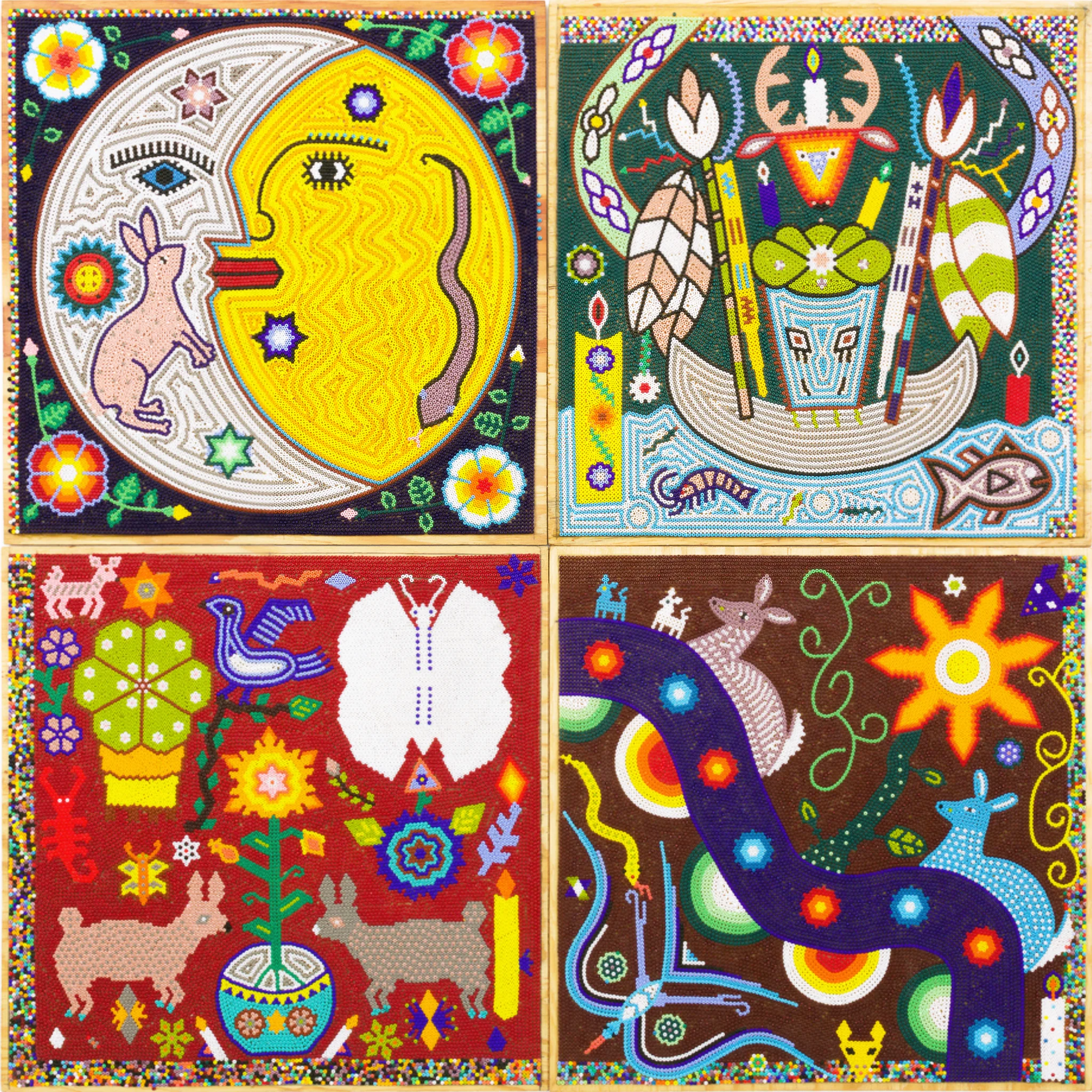
The sun and the moon, both with faces, fill one of the four panels, with a rabbit inside the moon; another holds a canoe on the water, carrying a deer's head, candles, feathers and a bowl. In the yarn paintings of Guadalupe González Ríos (Ketsetemahé Teukarieya), as the Wixárika Research Center publishes them, the moon is Takutsi Metseri, “Our Grandmother Moon,” and the sun is Tayeu, “the Sun, Our Father.”
In Tutukila Carrillo Sandoval's 1973 yarn painting The Founding of the World: After the Flood, as the Wixárika Research Center publishes it, Tatutsí Maxakuaxí, Our Great Grandfather Deer Tail, eats his antlers, "and for his mistakes he is transformed into the rabbit, tatsiu."
Mexico's Instituto Nacional de Antropología e Historia (INAH) writes that Wixárika offerings of candles “representan la luz del Sol y la conexión con las deidades” (represent the light of the Sun and the connection with the deities), and that feathers stand for the birds of the sacred hills, “mensajeras entre el mundo terrenal y el divino” (messengers between the earthly world and the divine).
The two banded shafts standing in the canoe, feathered at the top, are drawn like ceremonial arrows: Art of the Huichol Indians (1978) writes that "Uru, or ceremonial arrows, are the most common" offerings, that "By analogy with the flight of birds, they represent a message to the deities," and that "The rear shaft is decorated with painted bands, often of different colors for the different deities," and Juan Negrín writes in The Huichol Creation of the World (1975) that such an arrow's shaft "is painted with zig-zag designs (lightning) and circular bands, usually in two colors."
October Gallery in London showed this work, as Untitled, in Portal II: Inside the Cordillera (November 2019 to February 2020), together with Toto Xaweri: Sonido de Música (Toto Xaweri: Sound of Music) and Teteaikutzi.
Shown
- 2019Portal II: Inside the Cordillera, October Gallery, London