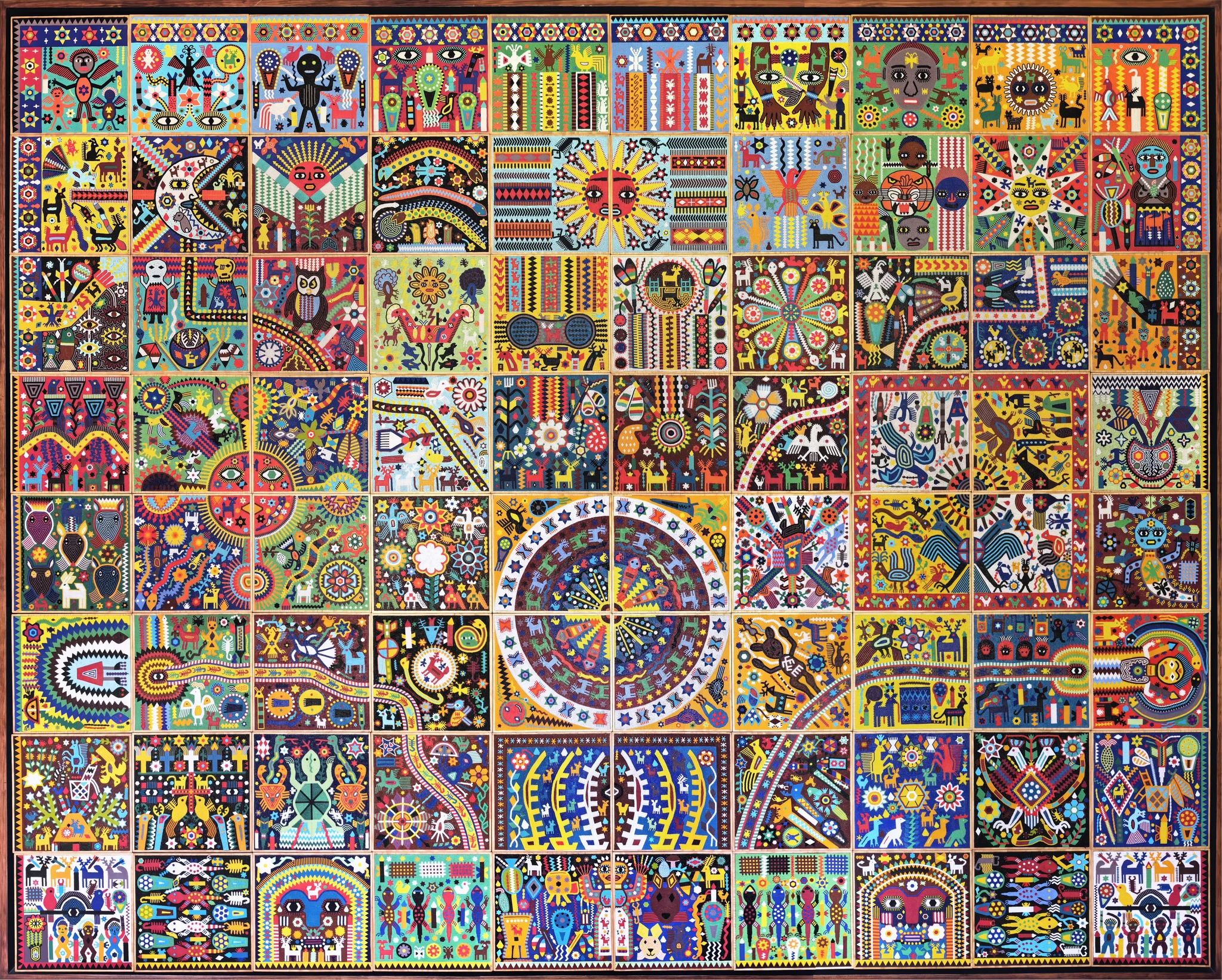
Untitled
Santos Motoapohua de la Torre (1942–)
2022
Beads, beeswax and plywood · 240 × 300 cm
Deep diveThis mural repeats, panel for panel with some changes, a composition Santos Motoapohua de la Torre has used for his large murals since the 1990s. Misterio y viaje de los tres espíritus sagrados, Pensamiento y alma huichol in the Paris Métro (1997), Visión de un mundo místico in Zacatecas (2000–01) and El nuevo amanecer in Chicago (2003) are each made of 80 square panels, ten across and eight down, with a large disc at the center. It is closest to El nuevo amanecer, which the National Museum of Mexican Art in Chicago holds: where it departs from the Paris mural, it follows the Chicago one.
RATP, the Paris transit authority, describes Pensamiento y alma huichol as a composition in three levels: the underworld in the bottom 30 panels, the earth in the middle 20 and the sky in the top 30. De la Torre has said his murals are read from the bottom up: “Los hombres cuando nacen, crecen de abajo hacia arriba, por eso es que los murales también se leen de esa manera” (people grow from the bottom up once they are born, and that is why the murals are read that way too).
In the reading of Misterio y viaje by Juan Manuel López Rodríguez of the Universidad Autónoma Metropolitana, the three sacred spirits stand along the bottom. At the center of the bottom row is Tatewari, Grandfather Fire, the highest deity. To the left of Tatewari, as he writes (on the viewer's left in his diagram), is Tatutsi Maxacuasi, Grandfather Deer-Tail, the peyote and historical memory, and to the right Tacutsi Nacawé, the Grandmother, the creation of life. From Tatewari's dwelling a road of scorpions runs to the left and a road of butterflies to the right, and two lower roads lead to two equipales, or seats: a dark one facing the night at the left end of the second row from the bottom, and a luminous one facing the sunrise at its right end.
For López Rodríguez the disc at the center is Tapari Tatewari, which depends on Grandfather Fire and stands for the four elements, air, fire, water and earth: “todo gira alrededor de un elemento central” (everything turns around a central element). Julieta Medina Briones, who directed the Museo Zacatecano, calls the center of Visión de un mundo místico the “Tepari de Tatehuari”, the “Abuelo Fuego” (Grandfather Fire).
In López Rodríguez's reading, one road rises from the disc to the moon, Jarianaca Metzeri, the feminine, in the upper left, passing through the fields of evil and punishment and the owl. The other rises to the eye of the sun, Xurawe Temai, the masculine, in the upper right, crossing the elements of the resurrection of Tatewari. The top of the mural, as he reads it, is Wiricuta, the final destination and the place of the peyote. De la Torre himself, at the Museo Zacatecano, said parts of Visión de un mundo místico stand for “los ojos del mundo, y los caminos del infierno y del cielo, de donde sale el sol” (the eyes of the world, and the roads of hell and of the sky, where the sun comes up), without saying which road is which.
In the second row from the bottom, next to the right end, is a two-headed bird. A Museo Zacatecano photograph of the same panel in Visión de un mundo místico titles it “Huerica Huimari (Espíritu del Cielo y Tierra)” (Spirit of the Sky and Earth). On the back of one of his yarn paintings, Juan Ríos Martínez wrote of “the two-headed eagle of the skies,” in the translation of Juan Negrín, founding director of the Wixárika Research Center. Negrín writes that in that painting the eagle reaches its place as Our Mother Eagle Girl, Tatéi Werika Wimari, a name close to the label's Huerica Huimari.