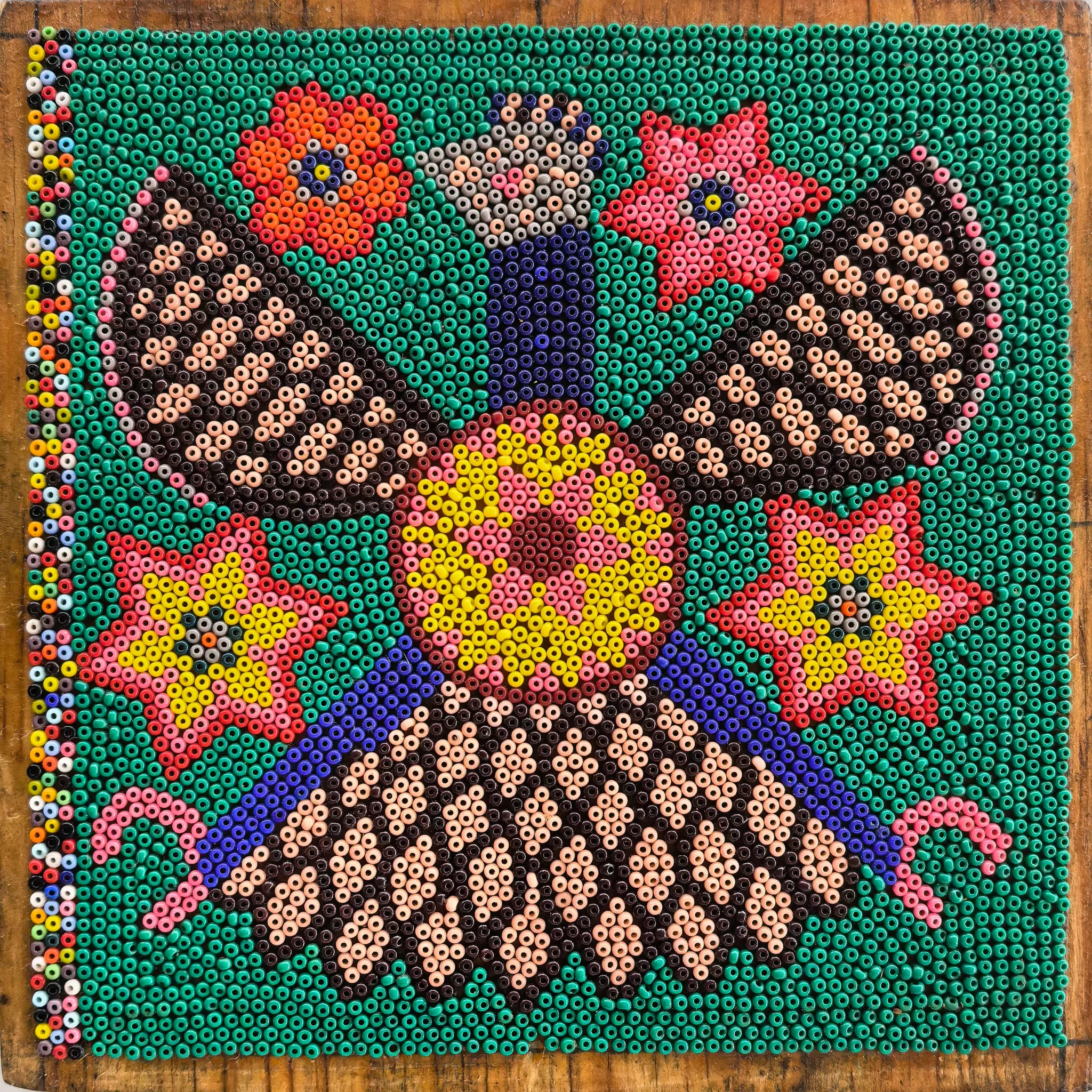
El ave que suelta agua divina para la salud
Santos Motoapohua de la Torre (1942–)
Beads, beeswax and plywood · 15 × 15 cm
The back is inscribed and signed: "El ave que suelta agua divina para la salud hecho por Santos M. de la Torre de Santiago y familia" (The bird that releases divine water for health, made by Santos M. de la Torre de Santiago and family).
A bird with outspread wings fills the piece. In its guide to the Wixárika Route, Mexico's Instituto Nacional de Antropología e Historia (INAH) writes that feathers, worn in headdresses and set in gourd bowls and offerings, represent the birds of the sacred hills, "mensajeras entre el mundo terrenal y el divino" (messengers between the earthly world and the divine).
The title names divine water given for health. The anthropologist Johannes Neurath, of Mexico's Museo Nacional de Antropología, said that in the Wixárika view the gods sacrifice themselves for the good of humanity and give as their most precious gift the "agua bendita" (holy water) of the rain, and that in simple farming rites, above all those held in family yards, offerings are exchanged "por lluvia y salud" (for rain and health).
The anthropologist Stacy B. Schaefer, of California State University, records a Huichol shaman's account of how a shaman is trained: the apprentice "brings sacred water from faraway places" and prays to the gods for the power to heal.
Three five-pointed stars and a flower are set around the bird. The Facebook page Orgullo Wixarika, which writes of the Wixárika as "nuestro pueblo" (our people), calls a star at the center of a beaded piece a "símbolo de guía y conexión espiritual" (symbol of guidance and spiritual connection). In the interpretation by Juan Negrín, who with Yvonne Negrín founded the Centro de Investigación Wixárika, of a yarn painting by Guadalupe González Ríos, flowers "represent prayers for life and abundance".