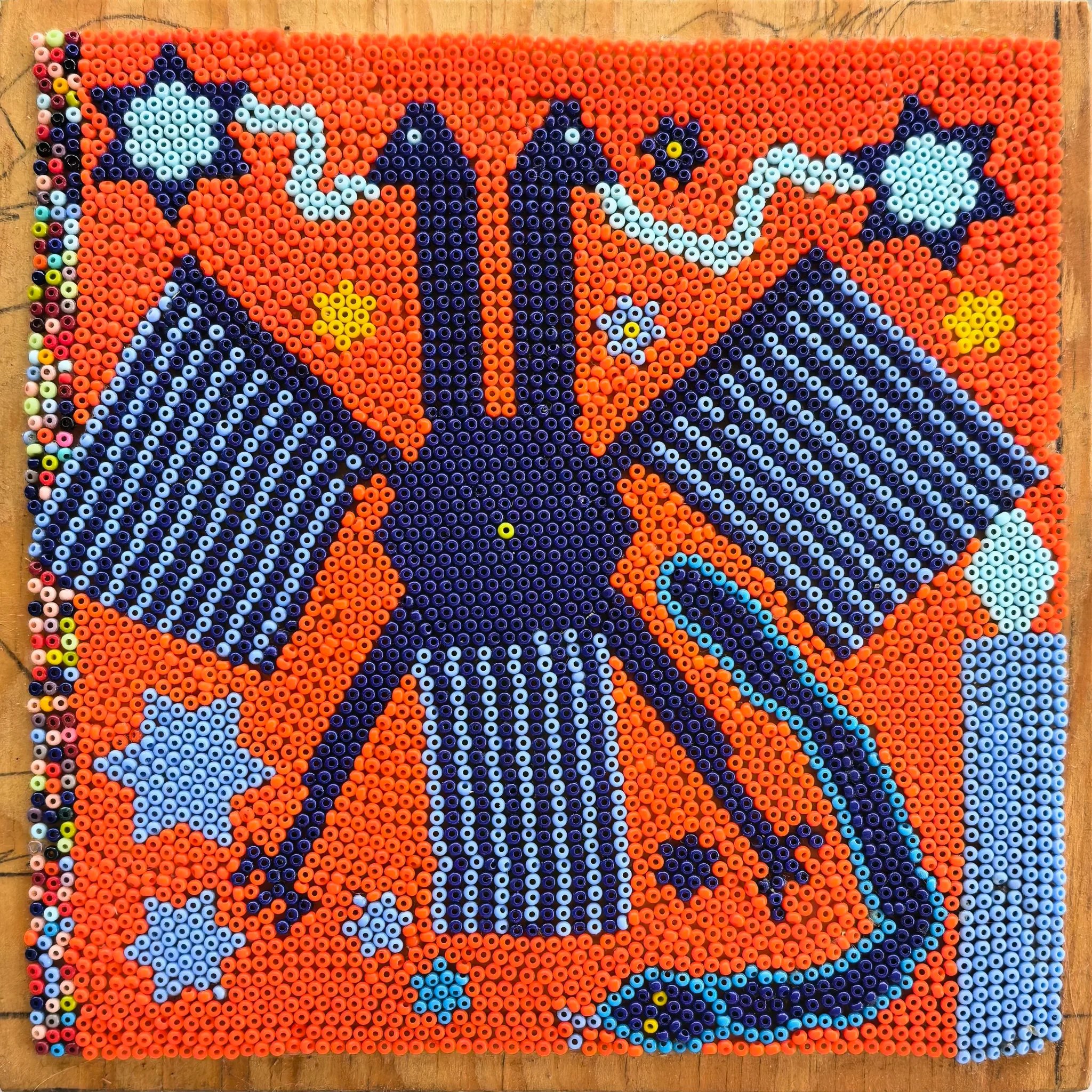
El águila espiando para alimentarse
Santos Motoapohua de la Torre (1942–)
Beads, beeswax and plywood · 15 × 15 cm
The back is inscribed and signed: "El aguila espiando para alimentarse hecho por Santos M. de la Torre de Santiago y familia" (The eagle watching for its food, made by Santos M. de la Torre de Santiago and family).
The piece shows a double-headed eagle and a serpent. On the back of his yarn painting Visiones del Venado Azul, Juan Ríos Martínez wrote of "el Águila, que es el águila de dos cabezas de los cielos" (the Eagle, which is the two-headed eagle of the skies). In its 1963 catalog of the Musée de l'Homme's Huichol collections, M. Simoni-Abbat shows "aigles bicéphales" (double-headed eagles) embroidered on a man's shirt, and writes that Tate Welika Vimali, the "Jeune-mère-aigle" (Young Mother Eagle), "règne sur les régions supérieures" (reigns over the upper regions) and "veille particulièrement sur les récoltes" (watches especially over the harvests).
In José Benítez Sánchez's account of his yarn painting El nierika de Kauyumarie, explained and translated by Juan Negrín from a recording, the eagle is Tatéi Werika Wimari, "Nuestra Madre Joven Águila de la Bóveda Celeste" (Our Young Mother Eagle of the Sky Vault), and the serpent "es la lluvia que surge de un árbol" (is the rain that springs from a tree).
In a version of the Wixárika maize story collected around 1937 and summarized by Héctor M. Medina Miranda, of the Universidad Autónoma de San Luis Potosí, the maize mother asked Tatei Wexika Wimari (as Medina spells her name), "diosa madre águila" (the mother eagle goddess), to guard the crops and punish those who stole the grain. From then on the thieving animals went out only at night, "para evitar ser devorados por el ave" (to avoid being eaten by the bird).
A candle stands beside the eagle. In its guide to the Wixárika Route, Mexico's Instituto Nacional de Antropología e Historia writes that candles "representan la luz del Sol y la conexión con las deidades" (represent the light of the Sun and the connection with the deities).