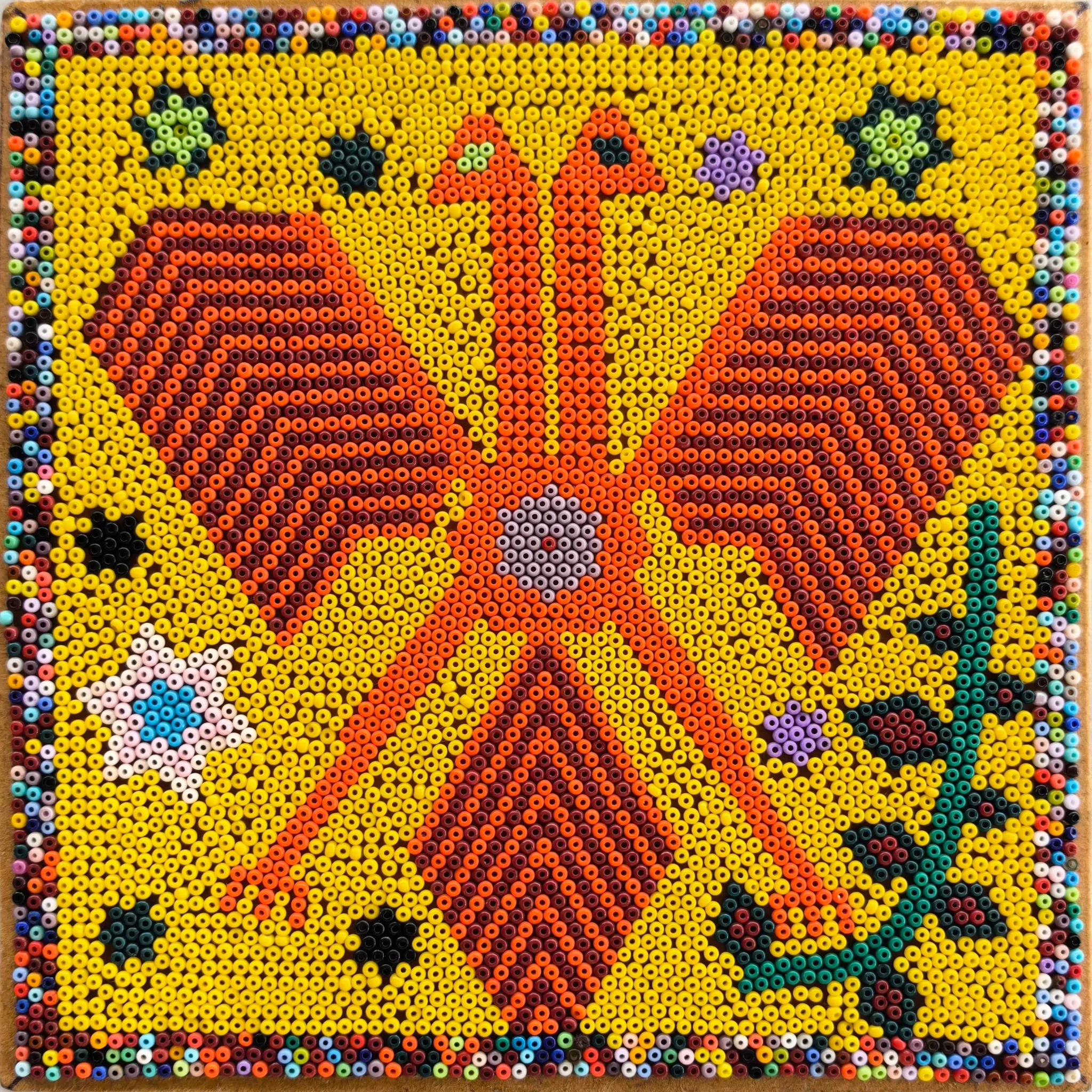
Águila sanador de la montaña
Santos Motoapohua de la Torre (1942–)
Beads, beeswax and plywood · 15 × 15 cm
The back is inscribed and signed: "Aguila sanador de la montaña hecho por Santos Motoaopohua de la Torre y familia" (Healing eagle of the mountain, made by Santos Motoaopohua de la Torre and family).
The piece shows a double-headed eagle. On the back of his yarn painting Visiones del Venado Azul, Juan Ríos Martínez wrote of "el Águila, que es el águila de dos cabezas de los cielos" (the Eagle, which is the two-headed eagle of the skies). In José Benítez Sánchez's account of his yarn painting El nierika de Kauyumarie, explained and translated by Juan Negrín from a recording, the eagle is Tatéi Werika Wimari, "Nuestra Madre Joven Águila de la Bóveda Celeste" (Our Young Mother Eagle of the Sky Vault). In its 1963 catalog of the Musée de l'Homme's Huichol collections, M. Simoni-Abbat shows "aigles bicéphales" (double-headed eagles) embroidered on a man's shirt, and writes that Tate Welika Vimali, the "Jeune-mère-aigle" (Young Mother Eagle), "règne sur les régions supérieures" (reigns over the upper regions) and "veille particulièrement sur les récoltes" (watches especially over the harvests).
In its guide to the Wixárika Route, Mexico's Instituto Nacional de Antropología e Historia writes that the birds of the sacred hills, "como el águila real" (such as the golden eagle), are "mensajeras entre el mundo terrenal y el divino" (messengers between the earthly world and the divine).