The Morrison Formation is a sequence of Late Jurassic sedimentary rocks in western North America, named for exposures near Morrison, Colorado. The U.S. Geological Survey records it in twelve states, Wyoming and Montana among them. The National Park Service dates it to about 157 to 150 million years ago and Britannica, from radiometric dating, to 155 to 148 million; a 2026 study of its fauna notes that there is still no consensus on a unified chronostratigraphic framework for it.
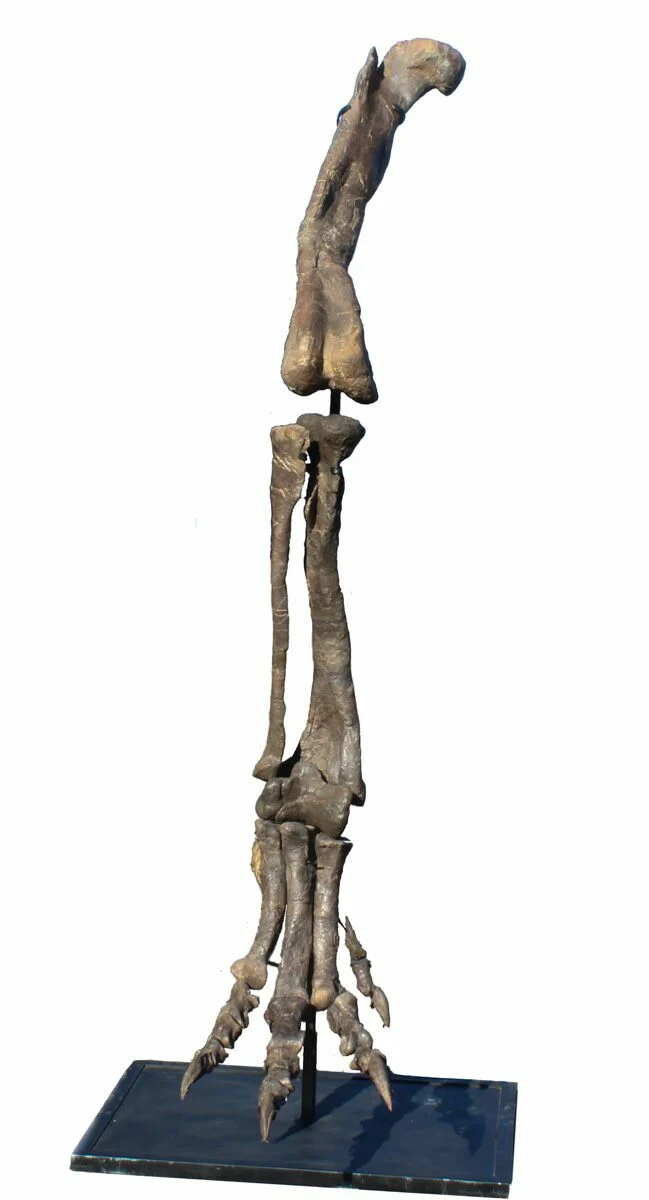
Finds in Colorado and at Como Bluff, Wyoming, in 1877 helped spur the “Bone Wars” between Othniel Charles Marsh and Edward Drinker Cope. Marsh named Allosaurus fragilis that year from a tooth, two vertebrae and a toe bone found at Garden Park, Colorado. Allosaurus is by far the most common meat-eating dinosaur found in the formation. In 1934 Barnum Brown of the American Museum of Natural History led the excavation of an estimated 3,000 to 4,000 bones at the Howe Quarry, north of Shell, Wyoming.
In 1991 a Swiss commercial company working near the Howe Quarry found a nearly complete Allosaurus skeleton, later known as Big Al. The site proved to be on public land, and the Museum of the Rockies in Bozeman, Montana, took over the excavation and holds the skeleton as MOR 693. In 2020 Daniel Chure and Mark Loewen named Allosaurus jimmadseni from a skeleton found at Dinosaur National Monument, Utah, and referred Big Al to it. They place the species in the lower part of the formation and list among its localities the Howe Stephens and Dana quarries in Wyoming's Big Horn and Washakie counties. In Montana most known Morrison sites lie along the state's southern border. The Mother's Day Quarry in south-central Montana had yielded over 2,500 dinosaur bones and skin fragments by 2021; almost all the bones are from juvenile and subadult Diplodocus.
In an opinion published in December 2023, the International Commission on Zoological Nomenclature designated the Smithsonian's skeleton USNM V 4734 as the neotype, the replacement type specimen, of Allosaurus fragilis. In December 2024 Andrew Danison and colleagues named Allosaurus anax from Oklahoma bones once referred to Saurophaganax maximus. In 2026 D. Cary Woodruff and colleagues described a neck vertebra from Montana's Pryor Mountains as the state's first Barosaurus; the same bonebed has yielded bones they identify only tentatively as Allosaurus.